

I stood at the squat rack, barbell loaded, trying to do math.
45 lbs on each side, times two, plus the bar… Is that 135? 140? I could never get it right. Plus: My training app logs my weights in kilograms, so now I had to convert on top of that. I stared at the ceiling, punched numbers into my phone calculator, gave up, and logged “heavy.” That was my life for two years.
Then one evening, in about twenty minutes, I built an app that fixed it.
The app was embarrassingly simple: It adds up the total weight of the barbell plates I was lifting, and gives it to me in kilograms and in pounds.
No social features, no cloud sync, not even a login. Just a weight calculator app for my gym.
For something that took twenty minutes to build, I was stupidly proud of it.
It started at a workshop
A colleague ran a workshop on vibecoding at Google: It was about how to build apps with AI without writing a line of code.
He fired up Google AI Studio and typed one sentence: “Make me a game with dinosaurs.” A minute later, a fully playable game appeared on screen with mechanics, a scoring system, and a cute dinosaur avatar. Then he typed “Add in a scoreboard” and it added one. “Change this button to blue” and the button turned blue.
I’d always assumed AI Studio was Gemini’s more intimidating cousin. The professional’s version, not for people like me. But when I watched my colleague build something real out of a couple of sentences, I felt the floor shift a little.
I went home and tried it.
The weights converter that changed everything
I picked a weights converter app for my first vibecoding test because it was stupid. If I was going to embarrass myself, better to do it on something nobody cared about.
I typed what I wanted into AI Studio: A simple calculator that converts barbell weights from pounds to kilograms and vice versa. It should allow me to input the different plates my gym has, and include a toggle for the barbell. It took me just two more prompts to iterate the app to this:
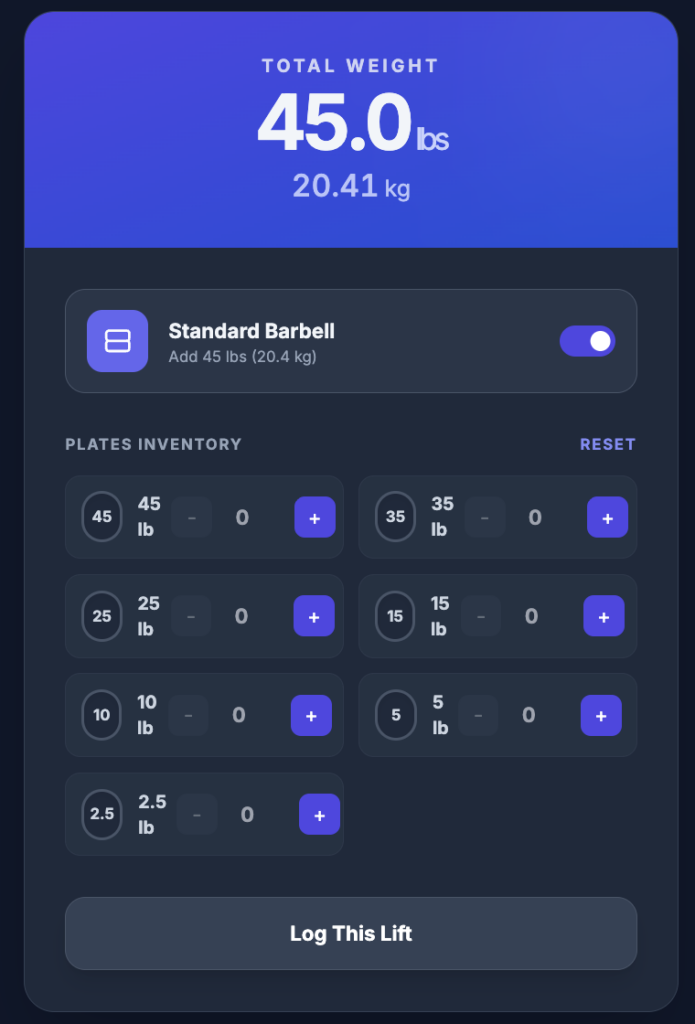
I took a couple more minutes to figure out how to deploy the app and add it to my phone… and I had a workable app! I used it at the gym the next morning, still feeling amazed that I would never have to do bad mental sums at the squat rack again.
Here’s the thing: you could probably find a similar app on the App Store. Probably hundreds of them. But none of them know that my gym has weight plates in 45 lbs, 25 lbs, 10 lbs, and so on. None of them have a toggle calibrated for my specific barbell. This one did, because I built it for my exact needs.
Nobody would buy this app. The market for “weights converter for one gym in Singapore” is precisely one person. But that one person uses it multiple times a week.
Tinkering with more apps
So I kept going.
The next app I built was a Miles Tracker. As I’ve shared before, I use credit cards which earn accelerated miles for different categories: Travel, dining, online spending, and mobile contactless. But every card has different spending caps for each month. Overspend past the cap, and you’re just leaving miles on the table.
I built a simple tracker to see at a glance which cards are still earning 4 mpd (miles per dollar) and which ones to put away until next month.
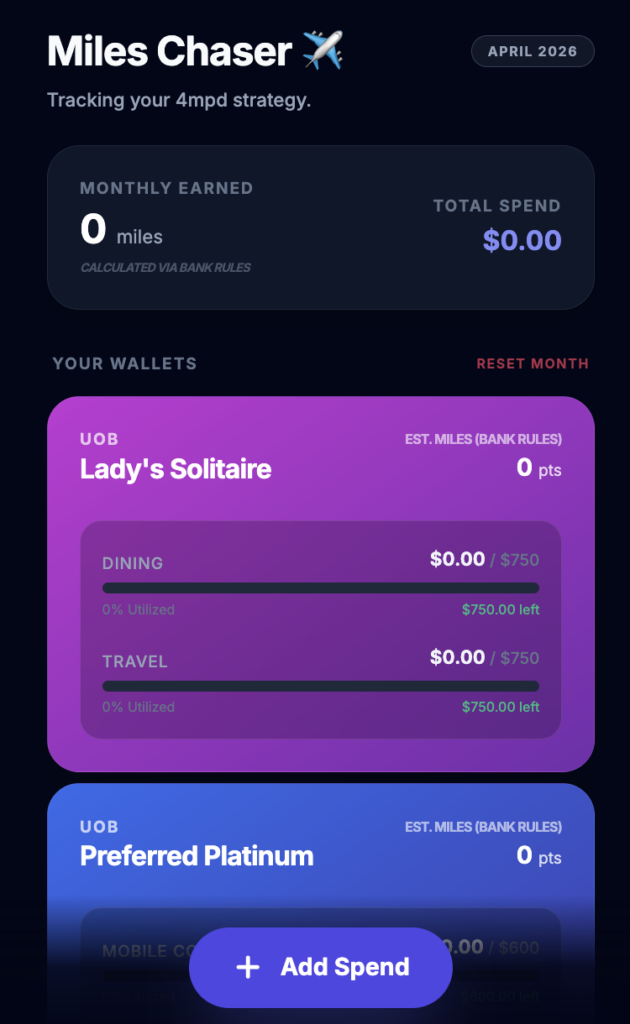
Does it feel clunky? Yes. But it saves me hundreds of dollars in miles every year, because I’m no longer mindlessly spending past the cap on autopilot.
My third app was my most ambitious one: A meal planner for my wife and I. My wife used to spend 2 hours planning our meals every week. She had to keep track of who was home for which meals, what we hadn’t eaten recently, what made sense for lunch versus dinner (e.g. beancurd with minced pork is a dinner dish, but never a lunch dish. Don’t ask me why, it just is), and then build a grocery list from there.
It took me a couple of hours, but I managed to build an app that automates all of it. You select who’s home on which day, the app assigns dishes to each slot from Monday to Friday based on who’s eating, and generates a grocery list.
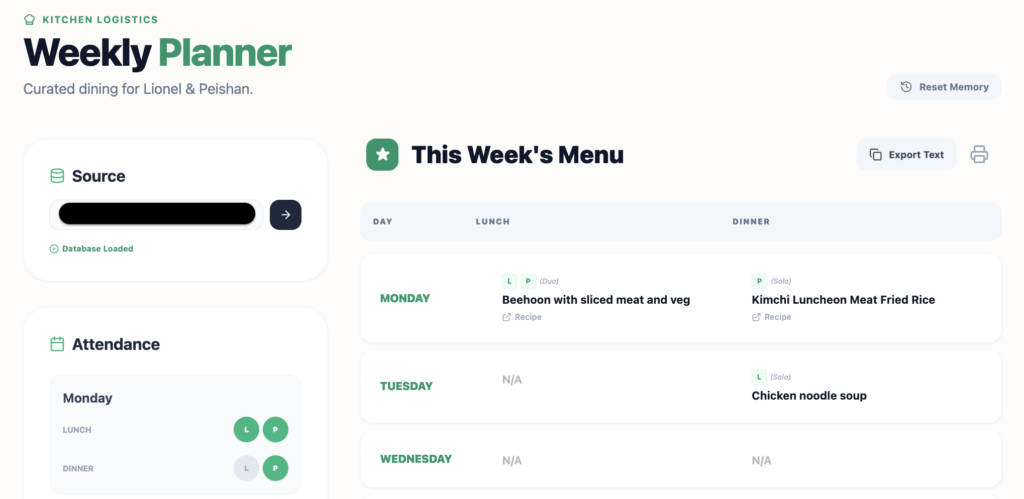
It’s not a beautiful piece of software. The UI looks like it was built by someone who’s never taken a design class (accurate). But my wife has clawed back hours every week, and she’s stopped being annoyed by wasted hours planning meals. Happy wife, happy life.
The question I stopped asking
The next natural question for the pragmatic Singaporean in me would be: Okay this is great, but how do I monetise this?!
For years, my mental model for apps was:
- Have a great idea
- Make sure it has a large Total Addressable Market
- Hire engineers to build it and a team to sell it
Wait for the VC bidding war to start- FINANCIAL FREEDOM
The reason why I never built anything was because I was always stuck on step 2.
Now, that model has collapsed. The only question I need to ask is: Does this solve MY problem? Does this work, for me, right now? Not: Would anyone else want this? Not: is there a market here?
It reminds me of the Google Sheet tracker I’ve used for ten years to manage my personal finances. Nobody else uses it. I built it for myself, because it solved a specific problem I had, and it accounts for the quirky nuances of my own financial planning.
Vibecoding is just what that same instinct looks like now. Except that instead of a spreadsheet, you get an actual app, sitting on your phone, doing exactly one thing exactly the way you need it done.
What LinkedIn gets wrong about vibecoding
On LinkedIn, the prevailing narrative is about how vibecoding is the new startup launchpad: Build your SaaS in a weekend, ship your MVP, quit your job, disrupt something. And sure, this version of the story exists.
But it’s not the interesting version.
The interesting version is boring. Vaughn Tan calls these “boring tiny tools“: high utility, highly customised, narrowly scoped, and built for one person’s exact situation.
It’s a gym app with a market of one. It’s a miles tracker for one person’s specific credit card situation. It’s a meal planner so specific it only works for one household. That’s why the apps you actually need don’t exist yet. They’re too specific to be commercially viable.
That’s exactly the gap vibecoding fills. If it’s too specific, too personal, too boring to ever be a startup, that’s the sweet spot.
You have a perfect useless app somewhere
Some small, specific, embarrassingly niche problem you’ve been solving badly for years. A workaround you’ve accepted as part of your routine. A mental calculation you do at the gym every morning.
You don’t need a pitch deck. You don’t need to validate the market. You don’t need to think about monetisation, or scalability, or whether anyone else would want this.
You could open AI Studio today, describe the specific problem you have and what you want, and see what happens.
It doesn’t have to be useful to anyone else. In fact, the less useful to anyone else, the better.
The best app you’ll ever make is one nobody would buy. Go build it.
Discover more from cheerful.egg
Subscribe to get the latest posts sent to your email.