
Have you heard of a Second Brain? In the world of productivity, it refers to a personal knowledge database for capturing, organising, and retrieving information. I’ve been using Google Keep as mine for the past three years, summarising every useful deck, report, or research piece so I can search for it later. (Here’s how I set mine up)
Why do I love it? Whenever I need information on a topic, say, YouTube brand marketing, I just search “YouTube Brand” and all my relevant notes surface instantly. It’s like having a personalised Google trained only on my data.
But there was a problem that nearly killed my whole system. In this post, I’ll talk about my biggest bottleneck in building a Second Brain, and how I used AI to solve it.
The Bottleneck That Almost Broke Everything
The biggest bottleneck of a Second Brain isn’t storing information; it’s processing it fast enough to make the storage worthwhile. Processing information was eating me alive. Every new deck meant I had to:
- Read through the entire thing carefully
- Extract the key points manually
- Type up my own summary with proper keywords
- Link it back to the original source
Sounds reasonable for one or two documents, right? But when you’re getting dozens of new reports weekly – market research, campaign analyses, measurement frameworks – it’s hard to keep pace with everything you have to read.
My “To Read” inbox piled up to over 50 reports, and the pressure to review it all grew with it. My Second Brain was causing me more stress instead of reducing it.
That’s when I realized something: The grunt work of information processing is exactly what LLMs excel at. I didn’t need AI to think for me, I needed it to pre-digest information so I could think more effectively.
My Two-Part AI Workflow for Information Processing
I spent some time crafting a prompt that transforms any long document into a searchable Second Brain note. It’s not about automation, it’s about augmentation.
Here’s the exact prompt I use:
Persona: Assume the role of an experienced business analyst with over 20 years of experience.

Task: I will upload a piece of content such as a deck, PDF or report. I would like you to summarise the main takeaways from this content in three parts:

Part 1: A high-level summary of no more than 5 main points.
Part 2: A more detailed summary. Include any key data points, surprising insights and useful analogies to help in my understanding. Replace vagueness with specific details.
Part 3: Generate a list of keywords that are linked to concepts in this deck. These keywords should help me to retrieve concepts when I search for them on Google Keep in the future.

Context: The output should help me to: 1) Quickly get a deep understanding of this content at both strategic and tactical levels, and 2) Easily search for this information in my Second Brain.

Format: Bold the main points. Remove inline citations. Begin section titles as *** Section Title *** for easy copying.
Each part serves a specific purpose:
The High-Level Summary gives me a 30-second overview before I dive into the full document. It’s like reading a book summary (Remember Blinkist?) before the actual book. It reduces cognitive load and helps me to scan content faster.
The Detailed Summary becomes my searchable archive. This is where the magic happens. Instead of generic takeaways, I get specific details like “Creatives drive 60% of digital marketing effectiveness” or “Attribution ROAS should be calibrated against MMM results using incrementality testing.” These details are what make the difference when I’m hunting for proof points months later while building a report or deck.
The Keywords act as tags, helping me categorize and surface the note later. When I search “MMM” or “incrementality,” this note pops up immediately.
Seeing This In Action
Last year, I came across Google’s Modern Measurement Playbook – 44 pages of incredibly detailed marketing measurement frameworks. It was one of the most useful resources I’d read, and I knew that I’d need to come back to it in the future.
I wasn’t well-versed with using AI back then, so I processed this playbook the old-fashioned way: I carefully read every page, and manually took detailed notes in Google Keep. The whole process took me an entire weekend (my wife was NOT happy about it).
Now that I’d built this prompt, I tested it on the playbook to see how well it would perform.
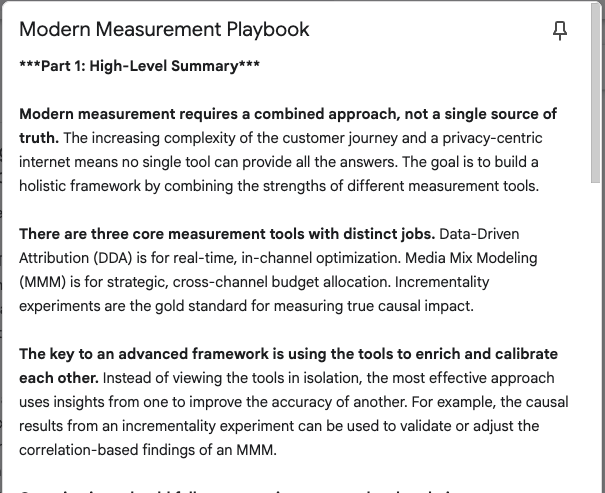
Within 30 seconds, Gemini gave me a comprehensive summary complete with key details and examples that I could immediately copy into Google Keep. Here’s a screenshot of what the high-level summary (Part 1) looks like:
And here’s part of the Detailed Summary (Part 2):
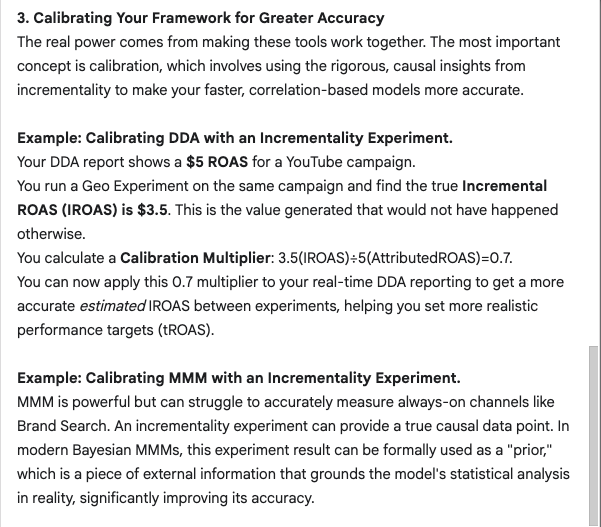
The real test came weeks later when a client asked about calibrating attribution models with media mix modeling. I searched “attribution MMM” in Keep, and there it was, complete with the specific methodology and examples I needed. The AI hadn’t just summarized; it had preserved the tactical details that make information actually useful.
It’s About Partnership, Not Replacement
Think of AI like elevators. Just because elevators exist doesn’t mean we stop exercising or taking stairs forever. We still need to stay fit and healthy. But we’d be dumb not to use elevators when we’re short on time or when we’re heading to the 30th floor.
LLMs work the same way. They can’t replace our ability to think critically about complex topics. But they can help us get through information faster by providing context and organization.
I still read every document I process and I still try to think deeply about the implications. I still connect dots between different pieces of research. But now I spend my mental energy on analysis and insight rather than mechanical summarisation.
In short, AI works best when you see it as reducing cognitive load, not replacing cognitive work.
What This Actually Looks Like Day-to-Day
My information diet has completely transformed. I’m no longer afraid of long, detailed reports because I know I can process them efficiently. My “To Read” inbox stays manageable. When colleagues reference obscure statistics or frameworks, I can quickly pull up relevant notes instead of frantically Googling.
Most importantly, I’m making better connections between different pieces of information because my Second Brain actually contains the details that matter, not just high-level summaries I wrote when I was tired.
This isn’t about finding the perfect productivity system, it’s about recognizing that the best tools amplify human capabilities rather than replace them. Your Second Brain still needs your first brain to work properly. AI just helps clear the path.
What’s your biggest challenge with staying on top of all the reports, articles, and research you need to read? How do you manage it all?